NATIVE PLANTS OF
COMMERCIAL IMPORTANCE
IN ALASKA
Part I: Weeds of Alaska Part II: USDA Hardiness Zones Map - Alalska Part III: Traditional Use of Medicinal Plants of Alaska Part IV: Herbaceous Plants of Alaska Part V: Herbaceous Plants of Alaska with Markets as Raw Materials Part VI: Other Potential Native Plants with Commercial Importance Part VII: Dried Mushroom Resources from Alaska PartVIII: Bulk Cones from Alaska and Canada Part IX: Books on Alaskan Native Plants Part X: Retail Market Resources Part XI: Typical Cottage Industry Ideas Part XII: Internet Resources
Definition
The Alaska Administrative Code defines noxious weeds as "any species of plants, either annual, biennial, or perennial, reproduced by seed, root, underground stem, or bulblet, which when established is or may become destructive and difficult to control by ordinary means of cultivation or other farm practices." The main differences between a common weed and a noxious weed are: the noxious weed's high capacity for destruction and the extreme difficulty in controlling or eradicating the invading species.Impact
The invasion of noxious weeds onto private and public lands causes substantial economic loss and ecological damage.Most noxious weeds are not native to the United States and have no natural controls in this country. Some were introduced through contaminated seed while others were intentionally introduced without the knowledge of their future destructive nature.
Left to spread without control these introduced plants can create severe problems for farmers, land managers, home owners and recreationists. The long term effects of uncontrolled spread can result in higher crop and livestock production costs, loss of native plants, degradation of wetlands and destruction of wildlife habitat. At risk are agricultural lands, forests, wilderness areas, parks and recreational sites
Introduction and Spread
Common sources for the introduction and spread of weed seed include the purchase, transportation and utilization of contaminated seed, forages and plant materials. The use of clean materials is a grower/user responsibility and an important step in limiting the spread of noxious weeds.Additionally, with free access to large amounts of unfenced public and private land in Alaska, the spread of weeds by human recreational activities is a potentially serious problem.
Regulations
Regulation and control of plant pests is authorized under Title 3 of the Alaska State Statutes. The Alaska Division of Agriculture is authorized to prevent the importation and spread of pests that are injurious to the public interest and for the protection of the agricultural industry.Regulations relating to noxious weed control are found in Title 11 Chapter 34 of the Alaska Administrative Code. The rules for establishment of quarantines, inspections, noxious weed lists (see below for Noxious Weeds in Alaska) and control measures are all provided for in current state regulations.
Private and public land owner control of noxious weed infestations is encouraged in lieu of government funded programs. Public education rather than enforcement is the preferred method for dealing with noxious weed problems.
Integrated Pest Management (IPM)
The focus of IPM is on long-term prevention or suppression of pests. The integrated approach to weed management incorporates the best suited cultural, biological and chemical controls that have minimum impact on the environment and on people.It is important to understand that IPM is not pesticide-free management. However, a successful IPM program should result in the most efficient use of pesticides if and when they are needed.
Preventing Spread
Protecting land that is not presently weed infested is the single most important management goal. The purchase of weed free seed, forages and plant materials can help to prevent the introduction of unwanted plants.Once noxious weeds are identified on agricultural land, their spread can be slowed by limiting traffic through the infested area and by thoroughly cleaning equipment and vehicles traveling between fields. Uncomposted manures that are known to contain weed seed should not be spread as fertilizer. New infestations should be treated immediately to minimize the cost of cleanup.
Weed seed is often spread by human recreational activities. Suggestions for limiting this type of spread include: not driving or camping in weed infested areas. Weed seeds can easily attach to vehicles, tires and camping gear. Before moving on, be sure to shake out tents, sleeping bags and clean your vehicle if you have been in areas which contain noxious weeds.
If pack animals or dogs are being used for transportation in the back country, use clean, weed free bedding and feed. Seeds contained in feed or bedding can be lost along the trail and start new populations in remote areas where control measures are difficult to apply. Before returning home from a backcountry trip remember to clean seed from your animals" hooves and coats.
Don't pick the flowers of unknown plants or transplant wild flowers that can't be identified. Noxious weeds can be spread by taking home bouquets or plant materials for landscaping.
If a weed infested area is found, let the land owner or management agency know so they can take steps to control the weeds.
Control
In areas where prevention has failed, control may be necessary. There are a number of questions that must be answered before the proper control measures can be determined. What is the invading plant? Is its presence threatening? What are the control options for the site as well as for the weed? How effective are the available controls? What is the most cost effective, low impact practice available?For further information on the control of specific weeds please contact your local Alaska Cooperative Extension district office.
Primary Noxious Weed List:Canada thistle
(Cirsium arvense)
Perennial, spread by seed and creeping roots; stems erect to 4 feet, branched near top; leaves alternate, irregularly lobed, spiny, dark green on top, white-hairy underneath; flowers white, rose or purple, diameter to 3/4 inch, grouped in small clusters.Perennial sowthistle
(Sonchus arvensis)
Perennial, spread by seed and creeping roots; stems erect to 5 feet, hollow with milky sap, branched near top; leaves alternate, crowded on lower half of stem and scarce near the top, more or less lobed with mildly prickly margins, leaves clasp stem at base; flowers bright yellow. diameter to 2 inches, grouped in small loose clusters.Quackgrass
(Agropyron repens)
Perennial, spread by seed and creeping roots; stems erect to 3 feet, upper portion smooth, lower sparsely hairy; leaves 1/4 to 1/2 inch wide, sparse hair on upper surface, underside glossy; claw-like appendages where leaves clasp stem; flowers arranged on slender 6-10 inch spike, flower clusters (spikelets) arranged in two long rows, borne flat-wise to stem.Field bindweed
(Convolvulus arvensis)
Perennial, spread by seed and creeping roots; stems slender vine-like and twining to 4 feet long; leaves alternate, arrowhead-shaped, length to 2 inches; flowers white to pinkish, funnel-shaped, diameter to 1 inch.Hoary cress
(Cardaria draba)
Perennial, spread by seed and creeping roots; stems erect to 2 feet, branched near top; leaves alternate, lance-shaped, grayish-green, length to 3 inches, finely toothed edges, covered with soft fine hairs; flowers white, 4 petaled, diameter to 1/4 inch, form dense flat-topped clusters.Russian knapweed
(Centaurea repens)
Perennial, spread by seed and creeping roots; stems erect to 3 feet, often branched from base, leaves alternate, length to 4 inches, lower leaves lobed or sharply toothed, upper leaves not lobed but finely toothed; flowers borne singly at end of branches, diameter to 1/2 inch, color-pink to lavender.Austrian fieldcress
(Rorippa austriaca)
Perennial, spread by seed and creeping roots; stems slender, erect or sprawling to 3 feet, branched near top; leaves alternate, smooth, length to 3 inches, lower leaves more distinctly toothed than upper; flowers bright yellow, 4 petaled, diameter to 1/8 inch, in loose clusters at tips of branches.Leafy spurge
(Euphorbia esula)
Perennial, spread by seed and creeping roots; stems thickly clustered, erect to 3 feet; leaves alternate, narrow, lance-shaped, length to 4 inches; flowers yellowish-green, diameter 1/8 inch, in numerous small clusters, each cluster surrounded by a pair of heart-shaped yellow-green bracts (leaves); plant contains a milky sap.Blue lettuce
(Lactuca pulchella)
Perennial, spread by seed and creeping roots; stems erect to 4 feet; leaves alternate, smooth, bluish-green, lance-shaped on upper stem, lower leaves deeply notched, length to 6 inches; flowers blue to purple, diameter to 1 1/4 inch; plant contains a milky sap.HorsenettleSolanum
(Solanum carolinense)
Perennial, spread by seed and creeping roots; stems erect to 4 feet, sometimes branched, covered with prickly hairs and spines; leaves alternate, length to 7 inches, coarsely toothed, covered with tiny hairs, long spines down the midrib and veins on the lower leaf surface; flowers blue, violet or white, star-shaped, 5 petaled, diameter to 1 inch, look like potato flowers.Smallflower galinsoga
(Galinsoga parviflora)
Annual, spread by seed; stems erect or spreading, branched, to 2 1/2 feet; leaves opposite, oval, pointed at the tip with finely toothed edges, surfaces mostly smooth, length to 3 inches; flowers white, diameter to 1/2 inch, in small loose clusters at tips of branches.
Hempnettle
(Galeopsis tetrahit)
Annual, spread by seed; stems erect, hairy, branched, to 3 feet; leaves opposite, lance-shaped, oval at leaf base, hairy above and below, length to 4 inches, with rounded or pointed teeth; flowers white or pink with purple markings, diameter to'/: inch, borne at the juncture of the upper leaves and stems.
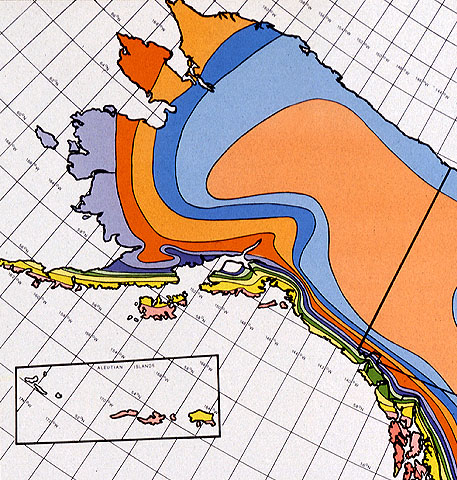
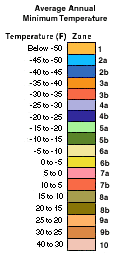
Check the color of the section in your area of the map with the color key above: Zones 1 through 7b represented. Source: US National Arboretum
Part III
TRADITIONAL USE OF MEDICINAL PLANTS
OF ALASKA
We are thrilled to announce the completion of the publication, Medicinal Flora of the Alaska Natives, by Ann Garibaldi.
This book is a compilation of traditional medicinal plant use by Alaska Natives from across the state. It is intended to be a reference source for existing literature on traditional plant healing. The book is an example of the strong heritage that comprises Native Alaska. We hope that you enjoy reading it as much as we had working on it. Check your local library to view a copy.If you would like to find out more about this publication, please read on through this webpage, or contact Ann Garibaldi. (Note that Ann is currently in graduate school in British Columbia).
To order your own copy contact:Judy Alward
Information Services
Environment and Natural Resources Institute
707 A St.
Anchorage, AK 99501
Ph. 257-2732
Email: anjaa@uaa.alaska.edu
The cost per book is $25.00 . Checks should be made payable to the University of Alaska Anchorage.Goals and Objectives
Increase the awareness of the valuable heritage of medicinal plants in Native Alaska and further the understanding of methods to respect and value this knowledge.
To produce a useable booklet summarizing documented knowledge on traditional healing with plants in Alaska and distribute this booklet back to villages and communities throughout the state.
Develop a dynamic database creating permanent housing of traditional medicinal plant knowledge for future efforts involving traditional practices.
To produce products that will assist Native communities in identifying gaps in the documented heritage of medicinal plants for their region. We seek to encourage individuals to enhance knowledge involving traditional healing by laying the foundation for future efforts
Who is Involved/Our Sponsors
This project is a partnered effort between the Salamatof Native Association, Inc. (SNA), Native American Fish and Wildlife Society and the Alaska Natural Heritage Program.
Financial support comes from: The Alaska Humanities Forum , CIRI Foundation, Kongsgaard-Goldman Foundation, National Park Service and the U.S. Fish and Wildlife Service. In-kind services are being supplied by the Tanana Chiefs Conference, Inc.
We welcome any comments, suggestions or questions concerning the project. Contact us to find out how you can become involved.
How to Reach Us for More Information
To find out more about this project, please direct questions and comments to:
Ann Garibaldi
Alaska Natural Heritage Program
707 A St.
Anchorage, AK 99501
Ph. 907-257-2786
Fax 907-257-2789Resource Links
Databases
American Indian Ethnobotany Database
Phytochemical and Ethnobotanical Databases
Medicinal Plants of North America Database
AGIS Ethnobotany Database
Medicinal Plant DatabasesNative Plant Knowledge
Part
IV:
Terrestrial Herbs
· Achillea millefolium, Yarrow
· Actaea spp, Baneberries
· pachypoda, White Baneberry
· rubra, Red Baneberry
· Amerorchis rotundifolia, Round Leaf Orchis
· Anaphalis margaritacea, Pearly Everlasting
· Andropogon gerardii, Big Blue Stem
· Anemone spp, Windflowers
· canadensis, Canada Anemone
· quinquefolia, Wood Anemone
· Antennaria spp, Pussytoes
· microphylla, Little Leaf Pussytoes
· neglecta, Field Pussytoes
· plantaginifolia, Plantain Leaf Pussytoes
· Apocynum androsaemifolium, Common Dogbane
· Aquilegia canadensis, Wild Columbine
· Aralia spp, Sarsaparillas
· hispida, Bristley Sarsaparilla
· nudicaulis, Wild Sarsaparilla
· Arenaria lateriflora, Sandwort
· Arethusa bulbosa, Swamp Pink
· Aster spp, Asters
· ciliolatus, Fringed Blue Aster
· macrophyllus, Large Leaf Aster
· ptarmicoides, Upland White Aster
· puniceus, Swamp Blue Aster
· umbellatus, Flattop White Aster
· Astragalus canadensis, Milk Vetch
· Calamagrostis spp, Reed Grasses
· Calopogon puchellus, Grass Pink Orchid
· Calypso bulbosa, Fairy Slipper Orchid
· Campanula spp, Bell Flowers
· aparinoides, White Bell Flower
· rotundifolia, Harebell
· uliginosa, Swamp Bell Flower
· Carex spp, Sedges
· pensylvanica, Yellow Sedge
· Chelone glabra, Turtlehead
· Chrysanthemum leucanthemum, Ox Eye Daisy
· Cirsium muticum, Swamp Thistle
· Clintonia borealis, Blue Bead Lily
· Coeloglossum viride, Long Bracted Orchid
· Comandra spp, Bastard Toadflaxes
· livida, Northern Bastard Toadflax
· richardsiana, Bastard Toadflax
· Convolvulvus spithameus,Upright Bindweed
· Coptis trifolia, Goldthread
· Corallorhiza, Coralroot Orchids
· maculata, Spotted Coralroot
· striata, Striped Coralroot
· trifida, Early Coralroot
· Corydalis sempervirens, Pale Corydalis
· Cuscuta gronovii, Dodder
· Cypripedium spp, Ladyslipper Orchids
· acaule, Moccasin Flower
· arietinum, Ram's Head Ladyslipper (TH-MN)
· calceolus, Yellow Ladyslipper
· reginae, Showy Ladyslipper
· Epilobium spp, Willowherbs
· angustifolium, Fireweed
· coloratum, Purple Leaf Willowherb
· glandulosum, Northern Willowherb
· strictum, Downy Willowherb
· Erigeron strigosus, Common Fleabane
· Eupatorium spp,
· maculatum, Joe Pye Weed
· perfoliatum, Boneset
· purpureum, Sweet Joe Pye Weed
· Fragaria spp, Strawberries
· vesca, Woodland Strawberry
· virginiana, Wild Strawberry
· Galium spp., Bedstraws
· asparine, Cleavers
· asprellum, Rough Bedstraw
· boreale, Northern Bedstraw
· lanceolatum, Yellow Wild Licorice
· triflorum, Fragrant Bedstraw
· Gentiana spp, Gentians
· andrewsii, Closed Gentian
· crinita, Fringed Gentian
· Geranium bicknelli, Wild Geranium
· Gnaphalium obtusifolium, Sweet Everlasting
· Goodyera spp, Rattlesnake Plantain Orchids
· repens, Dwarf Rattlesnake Plantain
· tesselata, Greater Rattlesnake Plantain
· Hepatica americana, Round Lobed Hepatica
· Heracleum lantana, Cow Parsnip
· Heuchera richardsonii, Alumroot
· Hieracium spp, Hawkweeds
· aurantiacum, Orange Hawkweed
· canadense, Common Hawkweed
· scabrum, Rough Hawkweed
· Hierochloe odorata, Sweet Grass
· Houstonia longifolia, Common Houstonia
· Hypericum spp, St. Johnsworts
· majus, Common St. Johnswort
· virginicum, Marsh St. Johnswort
· Impatiens spp, Jewelweeds
· capensis, Spotted Jewelweed
· pallida, Pale Jewelweed
· Lathyrus spp, Sweet Peas
· japonicus, Beach Pea
· ochroleucus, Pale Pea
· venosus, Purple Pea
· Lilium philadelphicum, Wood Lily
· Liparis loeselii, Loesel's Twayblade Orchid
· Listera spp, Twayblade Orchids
· auriculata, Auricled Twayblade (EN-MN)
· convallarioides, Broad Leaf Twayblade (SSC)
· cordata, Heart Leaf Twayblade
· Lotus corniculatus, Bird's Foot Trefoil
· Maianthemum canadense, Canada Mayflower
· Malaxis spp, Adder's Mouth Orchids
· monophyllos, White Adder's Mouth (SSC)
· paludosa, Bog Adder's Mouth (EN-MN)
· unifolia, Green Adder's Mouth
· Matricaria maritima, Scentless Chamomile
· Melampyrum lineare, Cow Wheat
· Meliolotus spp, Sweet Clovers
· Mentha arvensis, Field Mint
· Mertensia paniculata, Tall Lungwort
· Mitella nuda, Naked Mitrewort
· Moneses uniflora, One Flowered Pyrola
· Monotropa uniflora, Indian Pipe
· Oenothera spp, Evening Primroses
· biennis, Common Evening Primrose
· parviflora, Small Flowered
· perennis, Sundrops
· Oxalis montana, Woodsorrel
· Petasites spp, Coltsfoot
· frigidus, Early Sweet Coltsfoot
· sagittatus, Sweet Coltsfoot
· Platanthera spp, Rein Orchids
· clavellata, Small Green Wood Orchid (SSC)
· dilatata, Tall White Bog Orchid
· hookeri, Hooker's Rein Orchid
· hyperborea, Tall Northern Bog Orchid
· lacera, Ragged Fringed Orchid
· obtusata, Blunt Leaf Orchid
· orbiculata, Large Round Leaf Orchid
· psycodes, Purple Fringed Orchid
· Pogonia ophioglossoides, Rose Pogonia
· Polygala paucifolia, Fringed Polygala
· Polygonatum spp, Solomon's Seals
· biflorum, Smooth Solomon's Seal
· pubescens, Hairy Solomon's Seal
· Polygonum cilinode, Fringed Bindweed
· Potentilla spp., Cinquefoils
· arguta, Tall Cinquefoil
· norvejica, Rough Cinquefoil
· tridentata, Wine Leaf Cinquefoil
· Prenanthes alba, Rattlesnake Root
· Prunella vulgaris, Self Heal
· Pyrola spp, Shinleafs
· asarifolia, Pink Shinleaf
· elliptica, White Flowered Pyrola
· minor, Lesser Pyrola (SSC)
· rotundifolia, Round Leaf Pyrola
· secunda, One Sided Shinleaf
· virens, Nodding Pyrola
· Ranunculus spp, Buttercups
· acris, Meadow Buttercup
· flammula, Spearwort
· Scutellaria spp, Skullcaps
· epilobiifolia, Common Skullcap
· lateriflora, Mad Dog Skullcap
· Senecio pauperculus, Northern Ragwort
· Sium suave, Water Parsnip
· Smilacina spp, False Solomon's Seals
· racemosa, False Solomon's Seal
· stellata, Starry False Solomon's Seal
· trifolia, Bog False Solomon's Seal
· Solidago spp, Goldenrods
· canadensis, Canada Goldenrod
· graminifolia, Grass Leaf Goldenrod
· hispida, Upland Goldenrod
· juncea, Early Goldenrod
· missouriensis, Prairie Goldenrod
· rigida, Stiff Goldenrod
· uliginosa, Bog Goldenrod
· Spiranthes ssp, Ladies' Tresses Orchids
· lacera, Northern Slender Ladies' Tresses
· romanzoffiana, Hooded Ladies' Tresses
· Stachys palustris, Common Woundwort
· Streptopus roseus, Rose Twisted Stalk
· Taraxacum officinale, Common Dandelion
· Thalictrum spp, Meadowrues
· dasycarpum, Tall Meadowrue
· dioicum, Early Meadowrue
· Trientalis borealis, Starflower
· Trifolium spp., Clovers
· Trillium spp, Trilliums
· cernuum, Nodding Trillium
· grandiflorum, Large Flower Trillium
· Uvularia spp, Bellworts
· grandiflora, Large Flower Bellwort
· sessilifolia, Sessile Leaf Bellwort
· Vicia spp, Vetches
· americana, American Vetch
· caracca, Tufted Vetch
· Viola spp, Violets
· adunca, Hooked Spur Violet
· blanda, Sweet White Violet
· canadensis, Canada Violet
· cucullata, Marsh Blue Violet
· incognita, White Swamp Violet
· nephrophylla, Northern Bog Violet
· novae-angliae, New England Violet
· pallens, Northern White Violet
· pensylvanica, Smooth Yellow Violet
· pubescens, Downy Yellow Violet
· renifolia, Kidney Leaf Violet
· rostrata, Long Spurred Violet
· septentrionalis, Northern Blue Violet
· Walsteinia fragarioides, Barren Strawberry (SSC)
Aquatic Herbs
· Acorus calmus, Sweet Flag
· Asclepias incarnata, Swamp Milkweed
· Bidens cernua, Nodding Bur Marigold
· Calla palustris, Wild Calla Lily
· Caltha palustris, Marsh Marigold
· Carex spp, Sedges
· lasiocarpa, Wool Fruited Sedge
· rostrata, Beaked Sedge
· Cicuta spp, Water Hemlocks
· bulbifera, Bulb Bearing Water Hemlock
· maculata, Spotted Water Hemlock
· Drosera spp, Sundews
· intermedia, Spatula Leaf Sundew
· rotundifolia, Round Leaf Sundew
· Eleocharis spp, Spike Rushes
· Eriocaulon septangulare, Pipewort
· Eriophorum spp, Cotton Grasses
· angustifolium,
· spissum,
· vaginatum,
· virginicum,
· Iris versicolor, Blue Flag
· Juncus effusus, Common Rush
· Lobelia dortmanna, Water Lobelia
· Lycopus uniflorus, Common Water Horehound
· Lysimachia spp, Loosestrife
· ciliata, Fringed Loosestrife
· terrestris, Swamp Loosestrife
· thyrsiflora, Tufted Loosestrife
· Menyanthes trifoliata, Bogbean
· Parnassia palustris, Northern Grass of Parnassus
· Phragmites communis, Reed Grass
· Polygonum spp, Smartweeds
· amphibium, Showy Smartweed
· coccineum, Scarlet Smartweed
· natans, Water Smartweed
· sagittatum, Tearthumb
· Pontedaria cordata, Pickerel Weed
· Ranunculus pensylvanicus, Bristly Crowfoot
· Sagittaria spp, Arrowheads
· graminea, Grass Leaf Arrowhead
· latifolia, Broad Leaf Arrowhead
· rigida, Sessile Fruited Arrowhead
· Sarracenia purpurea, Pitcher Plant
· Scirpus spp, Bulrushes
· acuta, Great Bulrush
· atrovirens, Green Bulrush
· Sium suave, Water Parsnip
· Sparganium spp, Bur Reeds
· Typha spp, Cattails
· angustifolia, Narrow Leaf Cattail
· latifolia, Common Cattail
Related Pages
· Flora
· Aquatic Plants, emergent, floating, and submerged
· Ferns and Fern Allies, the Ferns, Horsetails, and Clubmosses
· Mosses
· Shrubs, from tiny shrublet to small trees
· Trees, Aspen, Birch, and Cedar; Spruce, Pine, and Fir
· Fauna
· Birds, Woodpeckers, Owls, and Chickadees (and the other 7 year round residents)
· Mammals, Moose, Wolf, and Beaver country
· Reptiles & Amphibians, in a land of waters, it's mostly frogs
· Fish, Bass, Northern, Walleye, and Trout - and their finny foodchain
· Invertebrates, Ticks, Flys, Leaches, and Mosquitos - the welcoming land
· Earth
· Ecology,
· Geology,
· Limnology,
· Sky
· Aurora Borealis,
· Weather & Climate,
http://www.rook.org/earl/bwca/resources/index.html
Northwoods Flora
· Boundary Waters Canoe Area Plants, a short listing of common trees and forbs